

Watery Eyes
Blockage of the tear drainage system
Chronic, unexplained tearing is often caused by a blocked tear duct. At Sutherland Eye Surgeons, we offer minimally invasive procedures to restore normal tear drainage and provide lasting relief.
What is a blocked tear duct?
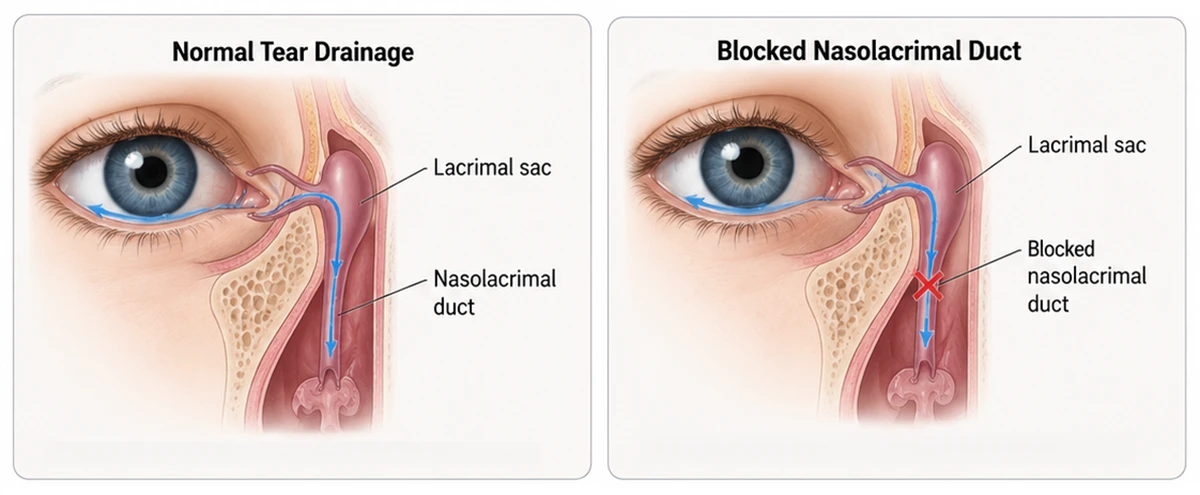
Normally, tears spread across the eye to keep it lubricated and then drain through small openings at the inner corner of the eyelids.
A blocked tear duct occurs when any part of this drainage pathway becomes obstructed, preventing tears from draining away. As a result, tears pool on the surface of the eye and spill over the eyelid margin, causing constant tearing.
Symptoms of a blocked tear duct
The persistent tearing may affect one or both eyes. You may also experience:
- Constant watery eyes, even when not crying or emotional
- Blurred vision due to pooling of tears on the corneal surface
- Skin irritation, redness, or soreness around the eyelids from frequent wiping
- Mucoid discharge, particularly in the morning
- Recurrent eye infections (conjunctivitis or dacryocystitis)
- Swelling or tenderness at the inner corner of the eye
- A sticky or crusty film over the eyelashes upon waking
Assessing a blocked tear duct
When you visit us at Sutherland Eye Surgeons, some of the tests that we perform may include:
Slit lamp examination
Evaluation of the ocular surface, puncta, and tear filmFluorescein dye disappearance test
A drop of dye is placed in the eye, and the rate at which it clears from the ocular surface is observed; delayed clearance indicates obstructionSyringing and probing
A gentle irrigation test performed in the clinic to determine whether the tear drainage pathway is open or blocked, and to identify the level of obstructionDacryocystography
An X-ray or CT study in which contrast dye is injected into the tear drainage system to visualise the site and extent of the obstructionNasal endoscopy
May be performed to assess the nasal passage and rule out intranasal pathologyCT or MRI imaging
May be used if a tumour or significant structural abnormality is suspected
Treatment for watery eyes
If watery eyes are a persistent problem, surgery is generally required to address the blocked tear duct causing the issues.
Dacryocystorhinostomy (DCR)
The definitive surgical procedure for chronic nasolacrimal duct obstruction. DCR creates a new drainage pathway from the lacrimal sac directly into the nasal cavity, bypassing the blocked duct.
Conjunctivodacryocystorhinostomy (CDCR)
For patients with obstruction in the upper portion of the tear drainage system, a more specialised procedure called conjunctivodacryocystorhinostomy (CDCR) may be required. This involves placing a small glass or silicone tube directly from the eye into the nasal cavity, creating an entirely new pathway for tears to drain. This procedure is typically reserved for cases where standard DCR surgery alone is not sufficient to resolve the blockage.
Are your eyes constantly watering?
If you are experiencing persistent tearing, you may have a blocked tear duct. Contact Sutherland Eye Surgeons for a specialist assessment. We'll identify the underlying cause and advise you if a surgical procedure can fix the issue.
For all appointments and enquiries, please phone 02 9521 8402
Monday
Tuesday
Wednesday
Thursday
Friday
8:30am – 5:00pm
8:30am – 5:00pm
8:30am – 5:00pm
8:30am – 5:00pm
8:30am – 5:00pm
Suite 5, Level 1
570 President Ave
Sutherland NSW 2232
Website by: 