

Macular Degeneration
Progressive loss of central vision
At Sutherland Eye Surgeons, we offer early detection and advanced treatments including intravitreal injections to slow the progression of AMD and protect your vision.
What is age-related macular degeneration?
Age-related macular degeneration (AMD) is a progressive condition affecting the macula, the central region of the retina responsible for sharp, detailed vision.
Dry (atrophic) AMD
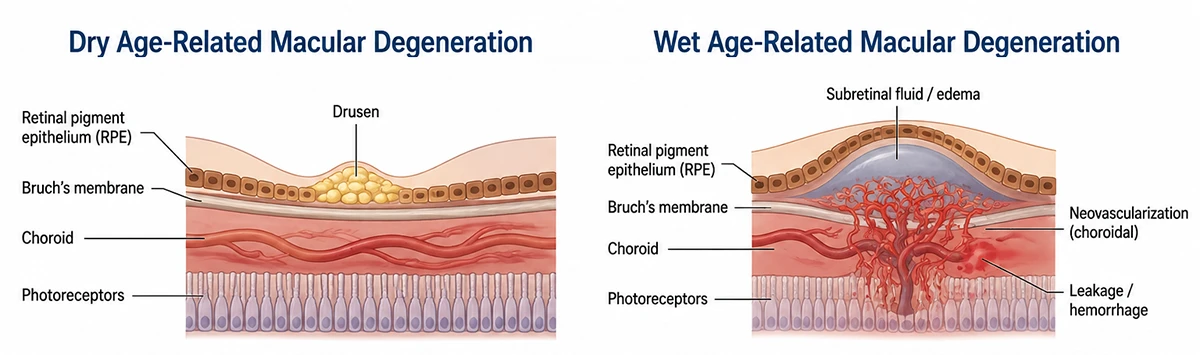
The more common form, accounting for approximately 85–90% of cases. It is characterised by the gradual accumulation of drusen (yellowish lipid deposits) beneath the retina and progressive atrophy of the retinal pigment epithelium. Progression is typically slow, occurring over many years.
Wet (neovascular) AMD
The less common but more severe form, where abnormal new blood vessels grow beneath the retina (choroidal neovascularisation). These fragile vessels leak fluid and blood, causing rapid swelling, scarring, and significant vision loss. Wet AMD can develop at any stage of dry AMD and requires urgent treatment.
Symptoms of age-related macular degeneration
Symptoms may develop gradually in dry AMD or suddenly in wet AMD. Common symptoms include:
- Blurred or distorted central vision
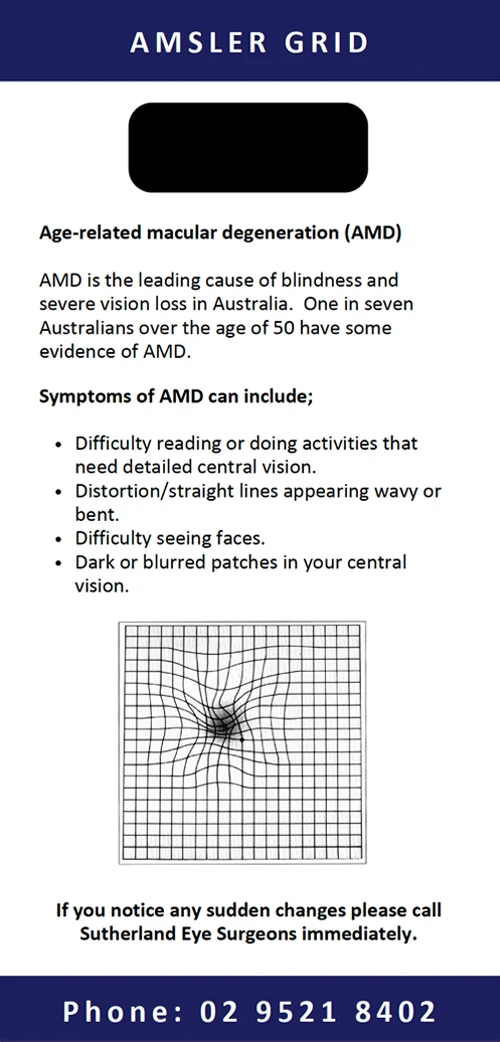
- Metamorphopsia (straight lines appearing wavy or bent)
- A dark, blurry area in the centre of vision (scotoma)
- Difficulty recognising faces
- Difficulty reading or performing tasks requiring fine vision
- Colours appearing less vivid or faded
- Increased need for brighter light when reading
- Difficulty adapting to dim lighting
In wet AMD, symptoms may develop suddenly and progress rapidly
Assessing AMD
When you visit us at Sutherland Eye Surgeons, some of the tests that we perform may include:
Visual acuity testing
Assessment of your best corrected visionRefraction
Evaluation of any refractive errorSlit lamp examination with fundoscopy
Examination of the macula, retina, and optic nerveOptical coherence tomography (OCT)
Non invasive, high resolution imaging that provides cross sectional images of the macula to detect and quantify fluid, drusen, and retinal thinning, and to monitor response to treatmentFundus photography
Colour photographs of the retina to document drusen and other changes, and to monitor progression over timeFluorescein angiography (FFA)
A dye is injected into a vein in your arm, and sequential photographs are taken as the dye passes through the retinal circulation. This is essential for detecting choroidal neovascularisation in wet AMDIndocyanine green angiography (ICG)
May be used in selected cases to visualise deeper choroidal vessels that are not visible with FFA
Amsler Grid monitoring at home
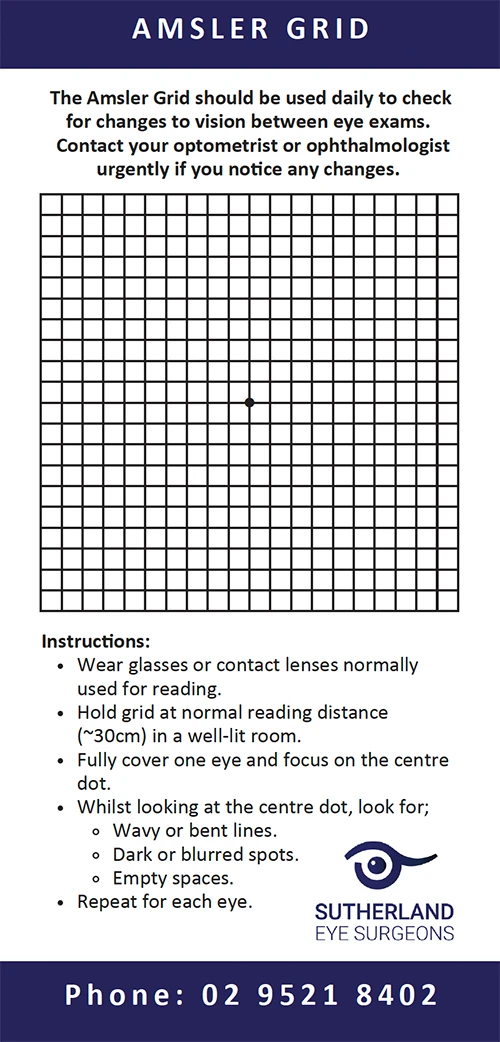
We recommend that patients with or at risk of AMD monitor their vision at home using an Amsler Grid.
This simple tool consists of a square grid of straight lines with a central dot. By covering one eye at a time and focusing on the central dot, you can check for any wavy, broken, or missing lines in your vision. If you notice any new distortion or changes, this may indicate progression of your AMD and you should contact our clinic promptly for review.
Regular self monitoring between appointments allows for early detection of changes and timely intervention, which is critical for preserving your vision.
Sutherland Eye Surgeons has complimentary Amsler Grids available to all patients and relatives.
Our grids have a magnet for easy placement on the fridge for regular checks.
Treatment of AMD
Dry AMD
For dry AMD, the AREDS2 formulation of nutritional supplements: vitamins C and E, zinc, lutein, and zeaxanthin has been shown to reduce the risk of progression to advanced AMD in patients with intermediate or advanced dry AMD. If you smoke, it's important to quit as soon as possible.
Wet AMD
Anti-VEGF injections are the most effective treatment for wet AMD. These medications block the protein that causes abnormal blood vessels to grow and leak, reducing swelling and preventing further damage. Injections are given in the clinic, usually every four to sixteen weeks depending on your response to treatment.
Is your central vision changing?
If you are experiencing blurred or distorted central vision, you might be developing AMD. Contact Sutherland Eye Surgeons today to find out if early treatment can preserve your eyesight.
For all appointments and enquiries, please phone 02 9521 8402
Monday
Tuesday
Wednesday
Thursday
Friday
8:30am – 5:00pm
8:30am – 5:00pm
8:30am – 5:00pm
8:30am – 5:00pm
8:30am – 5:00pm
Suite 5, Level 1
570 President Ave
Sutherland NSW 2232
Website by: 