

Glaucoma
Silent eye pressure changes that can affect your vision permanently
At Sutherland Eye Surgeons, we offer a range of treatment options including prescription eye drops, laser therapy, and advanced surgical procedures, to help preserve your vision and slow the progression of glaucoma.
What is glaucoma?
Often termed the "sneak thief of sight", glaucoma develops gradually and typically causes no symptoms until significant vision loss has occurred. Early detection through comprehensive eye examination is paramount, as any vision lost to glaucoma is permanent.
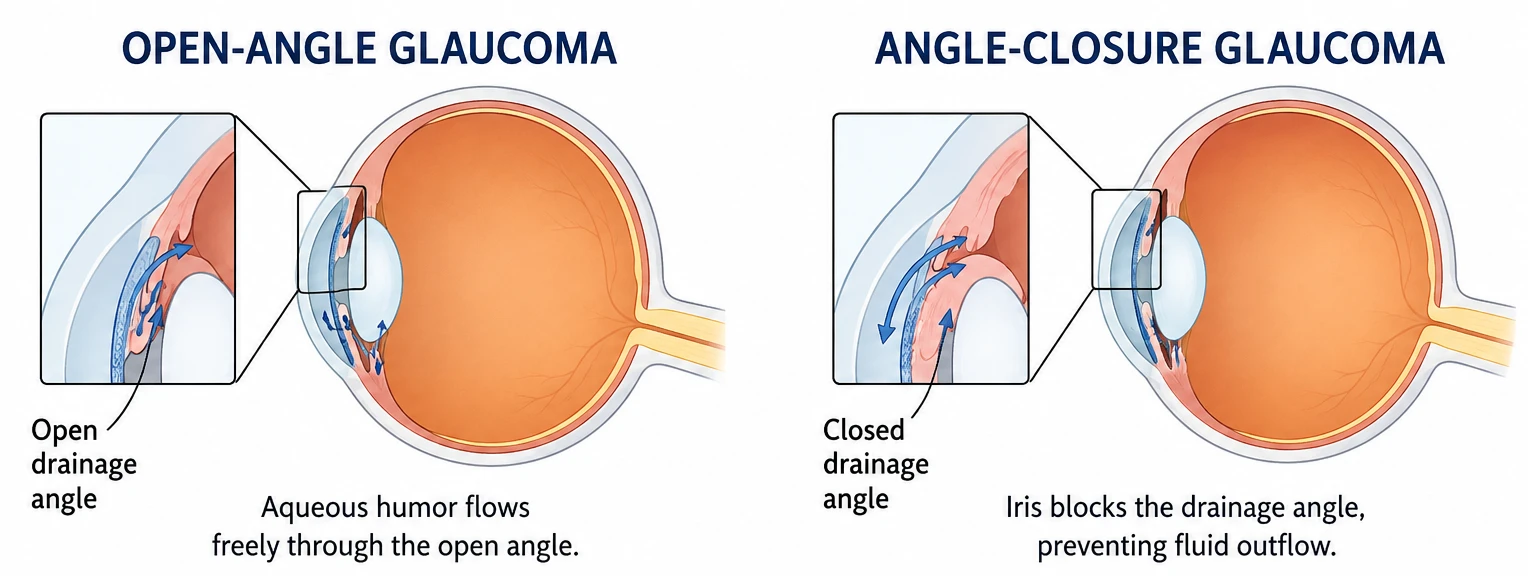
Primary open-angle glaucoma
The most common form, characterised by gradual optic nerve damage and progressive peripheral visual field loss. The drainage angle remains open, but the trabecular meshwork becomes less efficient over time.Angle-closure glaucoma
Less common but more acute, due to a narrow or closed drainage angle that prevents fluid from exiting the eye. Acute angle-closure glaucoma is an emergency, with symptoms including severe eye pain, headache, nausea, vomiting, blurred vision, and halos around lights.
Symptoms of glaucoma
In most cases, glaucoma has no early symptoms. This is why regular eye examinations are essential, particularly for those with risk factors.
Eventually, patients may experience:
- Gradual loss of peripheral (side) vision
- Tunnel vision in advanced stages
- Difficulty adapting to low light
- Reduced contrast sensitivity
Assessing glaucoma
When you visit us at Sutherland Eye Surgeons, some of the tests that we perform may include:
Visual acuity testing
Assessment of your best corrected visionRefraction
Evaluation of any refractive errorTonometry
Measurement of intraocular pressure using a tonometer. This may be performed with a contact method (applanation) or a non contact "air puff" method. Several readings may be taken throughout the day.Gonioscopy
A specialised lens is placed on the eye to visualise the drainage angle and determine whether it is open, narrow, or closedOptic nerve head evaluation
Examination of the optic disc for signs of damage, including cupping, notching, thinning of the neuroretinal rim, or haemorrhagesOptical coherence tomography (OCT)
Non invasive imaging that measures the thickness of the retinal nerve fibre layer and ganglion cell complex, detecting thinning before visual field changes occurVisual field testing (computerised perimetry)
Assessment of your peripheral vision using a computerised instrument that detects early areas of vision loss that you may not notice in daily lifeCorneal pachymetry
Measurement of corneal thickness, which influences the accuracy of pressure readingsFundus photography
Colour photographs of the optic nerve to document its appearance and monitor for changes over timeAnterior segment OCT
May be used to assess the drainage angle in detail, particularly if angle-closure glaucoma is suspected
Treatment of glaucoma
We will tailor your treatment based on the type and severity of glaucoma, as well as your overall health and lifestyle.
Eye drops
The most common first line therapy. Drops work either by reducing the production of aqueous fluid or by improving its drainage. Once daily preparations and fixed combination drops are available.
Selective laser trabeculoplasty (SLT)
An in rooms laser procedure that uses short, low energy pulses to stimulate the trabecular meshwork and improve aqueous drainage. Large clinical trials have demonstrated SLT to be as effective as drops for most patients initiating treatment, with the advantage of eliminating daily medication adherence. SLT can be repeated if required.
Minimally invasive glaucoma surgery (MIGS)
For patients with mild to moderate glaucoma requiring cataract surgery, our surgeons perform MIGS procedures (such as iStent) concurrently with cataract extraction. These micro invasive procedures create a bypass for aqueous outflow. In clinical trials, approximately two thirds of patients receiving iStent at cataract surgery were able to reduce or discontinue glaucoma drops, with no additional visual recovery time beyond that expected for cataract surgery alone.
Laser peripheral iridotomy (LPI)
For patients with narrow drainage angles at risk of angle-closure glaucoma, a YAG laser iridotomy creates a small opening in the iris to allow aqueous fluid to bypass the pupillary block and reduce the risk of acute angle closure. This is typically performed in your 'normal' eye if angle closure has occurred in the other eye.
Trabeculectomy
A filtering surgery that creates a controlled drainage pathway for aqueous fluid to exit the eye under the conjunctiva, forming a bleb. This is the traditional "gold standard" for uncontrolled glaucoma and remains highly effective, though it requires more intensive post operative monitoring and has a higher risk of complications than MIGS.
Over 50 or have a family history of glaucoma?
If your optometrist has identified signs of glaucoma or referred you for further investigation, contact Sutherland Eye Surgeons to arrange a comprehensive glaucoma evaluation. Our specialists will discuss the most appropriate treatment options for your individual needs.
For all appointments and enquiries, please phone 02 9521 8402
Monday
Tuesday
Wednesday
Thursday
Friday
8:30am – 5:00pm
8:30am – 5:00pm
8:30am – 5:00pm
8:30am – 5:00pm
8:30am – 5:00pm
Suite 5, Level 1
570 President Ave
Sutherland NSW 2232
Website by: 