

Flashes & Floaters
Spots or light flashes that may signal retinal problems
Floaters appear as small spots, cobwebs, or squiggly lines drifting across your vision, while flashes look like brief flickers or streaks of light. While often harmless, a sudden increase in floaters or the onset of flashes can signal a retinal tear or detachment, an eye emergency. We offer same day evaluations to distinguish benign changes from serious conditions requiring immediate laser or surgical treatment.
What are flashes and floaters?
Floaters are tiny clumps of cells, protein, or debris that form within the vitreous gel. As these opacities float through the vitreous cavity, they cast shadows on the retina, which you perceive as spots, cobwebs, or squiggly lines drifting across your field of vision. Floaters are often more noticeable when looking at a plain, bright background such as a white wall or blue sky.
Flashes (photopsia) appear as brief flickers or streaks of light in the peripheral vision. They are caused by mechanical traction on the retina as the vitreous gel pulls away from the retinal surface. This traction stimulates the retina to send signals to the brain that are interpreted as light, even though no external light is present.
While these changes are usually harmless, in some cases the vitreous may pull hard enough to cause a retinal tear. If fluid passes through this tear and accumulates beneath the retina, it can cause a retinal detachment, a true ocular emergency.
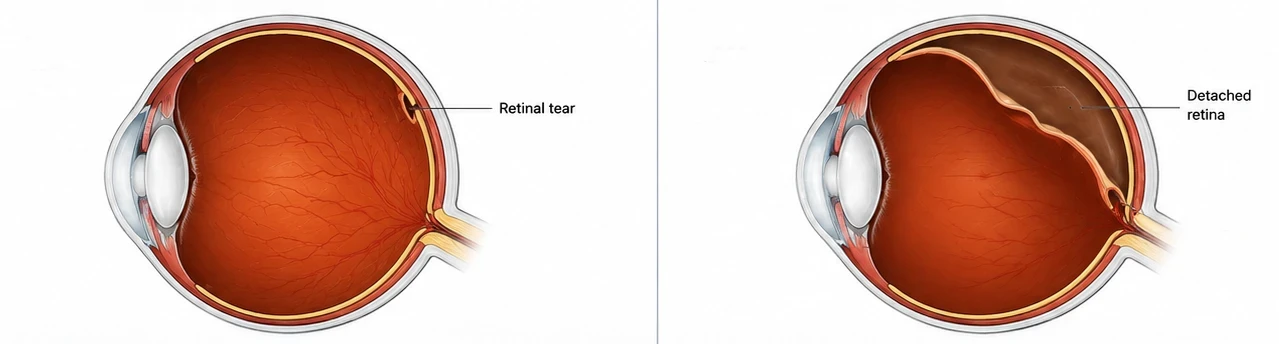
Symptoms of flashes and floaters
Common symptoms include:
- Small spots, dots, or lines drifting across your vision
- Cobweb like shapes
- Squiggly or thread like strands
- Brief flashes of light, particularly in the peripheral vision
- Flashes that are more noticeable in dim lighting or when moving your eyes
- A ring shaped floater (Weiss ring) in one eye
Warning signs requiring urgent attention:
- A sudden increase in the number of floaters (like a shower of black dots)
- A sudden onset of flashes
- A curtain like shadow or dark area progressing across your visual field
- A sudden decrease in vision
- A history of high myopia, prior cataract surgery, or ocular trauma
If you experience any of these warning signs, you should seek an urgent eye examination the same day.
Assessing flashes and floaters
When you visit us at Sutherland Eye Surgeons, some of the tests that we perform may include:
Visual acuity testing
Assessment of your best corrected visionSlit lamp examination
Evaluation of the anterior segment and assessment for any associated inflammation or bleedingDilated fundal examination
Drops are instilled to dilate your pupils, allowing a thorough examination of the retina, including the peripheral retina where tears most commonly occurScleral depression
Gentle pressure applied to the outside of the eye to allow visualisation of the far peripheral retina. This is essential to detect subtle retinal tears that may not be visible otherwiseOptical coherence tomography (OCT)
Imaging of the macula to assess for any associated pathology, including macular holes or oedemaB-scan ultrasonography
May be performed if there is significant bleeding (vitreous haemorrhage) that prevents clear visualisation of the retina
Treatment of flashes and floaters
For benign floaters
Reassurance and monitoring are provided. Most benign floaters become less noticeable over time as they settle out of the visual axis and as the brain learns to ignore them. Surgery to remove floaters is rarely indicated and is reserved for severe cases significantly affecting quality of life.
For retinal tears
Prompt treatment with in rooms laser photocoagulation or cryotherapy is performed to create a chorioretinal scar that seals the retinal break, preventing fluid from passing through and causing a detachment. This is a quick and simple procedure that takes approximately 10–15 minutes.
For retinal detachments
Surgery is required to reattach the retina and preserve vision. This may involve a vitrectomy (removing the vitreous gel and reattaching the retina), scleral buckle (placing a silicone band around the eye to indent the wall and relieve traction), or pneumatic retinopexy (injecting a gas bubble to push the retina back into place).
Have you noticed new flashes or floaters?
If you have experienced a sudden change in your vision, it could be an eye emergency. Contact Sutherland Eye Surgeons immediately to arrange a same day assessment.
For all appointments and enquiries, please phone 02 9521 8402
Monday
Tuesday
Wednesday
Thursday
Friday
8:30am – 5:00pm
8:30am – 5:00pm
8:30am – 5:00pm
8:30am – 5:00pm
8:30am – 5:00pm
Suite 5, Level 1
570 President Ave
Sutherland NSW 2232
Website by: 