

Epiretinal Membrane
Scar like tissue on the retina causing visual distortion
At Sutherland Eye Surgeons, our retinal specialists can perform delicate microsurgical procedures to gently remove the problem area on the retina that is causing your vision problems.
What is an epiretinal membrane?
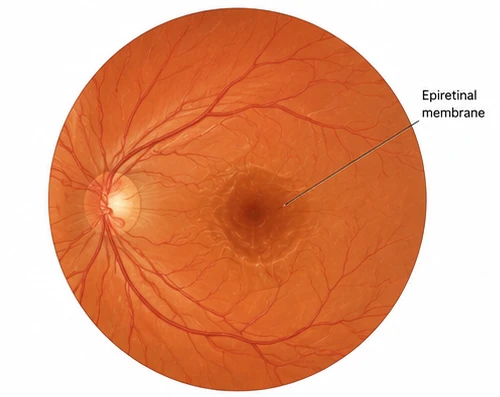
An epiretinal membrane (ERM) is a thin, fibrocellular layer of scar like tissue that develops on the surface of the retina, specifically on the internal limiting membrane. These cells, primarily glial cells and retinal pigment epithelial cells migrate and proliferate on the retinal surface, forming a membrane that contracts over time.
As the membrane contracts, it wrinkles and thickens the underlying retina, distorting the photoreceptors and disrupting the normal architecture of the macula, the central region responsible for sharp, straight ahead vision. Most epiretinal membranes are idiopathic (no identifiable cause), though they may also develop following retinal tears, inflammation, vascular disease, or prior eye surgery.
Symptoms of epiretinal membrane
Symptoms typically develop gradually and may affect one or both eyes:
- Blurred or hazy central vision that is not correctable with glasses
- Metamorphopsia (distortion where straight lines appear wavy or bent)
- Micropsia (objects appearing smaller than they actually are)
- Decreased contrast sensitivity
- Difficulty reading fine print
- A central dark or empty area in the visual field (scotoma) in advanced cases
- Difficulty recognising faces at distance
Assessing epiretinal membrane
When you visit us at Sutherland Eye Surgeons, some of the tests that we perform may include:
Visual acuity testing
Assessment of your best corrected visionRefraction
Evaluation of any refractive error that may be contributing to visual symptomsSlit lamp examination with fundoscopy
Examination of the retina to assess for the presence of an epiretinal membrane and any associated pathologyAmsler grid testing
A simple test where you view a grid of straight lines to detect areas of distortion or missing vision; patients with ERM often report wavy or missing linesOptical coherence tomography (OCT)
Non invasive, high resolution imaging of the macula that provides cross sectional images to confirm the presence of an epiretinal membrane, assess its thickness and traction on the retina, and detect any associated macular oedemaFundus photography
Colour photographs of the retina to document the membrane and monitor progression over timeFluorescein angiography (FFA)
May be performed in selected cases to assess for associated vascular leakage or to exclude other macular pathology
Treatment of epiretinal membrane
Many epiretinal membranes are stable and do not require intervention. However, when the membrane causes significant visual distortion or reduction in acuity that interferes with daily activities, surgical treatment is indicated.
If you are seeing us at Sutherland Eye Surgeons, we will discuss whether surgery is appropriate based on your symptoms, visual function, and OCT findings. The primary treatment for symptomatic epiretinal membrane is vitrectomy with membrane peeling. This is performed as a day only procedure under local anaesthesia with sedation. The surgeon creates three small incisions in the sclera, removes the vitreous gel, and uses micro instruments to gently peel the epiretinal membrane and underlying internal limiting membrane from the retinal surface. The eye is then filled with a saline solution or gas bubble, which gradually absorbs.
Following surgery, patients typically notice gradual improvement in distortion and visual clarity over weeks to months. Any gas bubble used will absorb naturally, and patients are advised to avoid air travel until the bubble has fully resolved. Most patients experience significant improvement in visual quality, with distortion often improving more rapidly than visual acuity.
Have you been diagnosed with an epiretinal membrane?
Your optometrist may have picked up on this issue when you had your eyes checked. Contact Sutherland Eye Surgeons today to find out if you are a candidate for surgical treatment.
For all appointments and enquiries, please phone 02 9521 8402
Monday
Tuesday
Wednesday
Thursday
Friday
8:30am – 5:00pm
8:30am – 5:00pm
8:30am – 5:00pm
8:30am – 5:00pm
8:30am – 5:00pm
Suite 5, Level 1
570 President Ave
Sutherland NSW 2232
Website by: 