

Ectropion / Entropion
Outward turning or inward rolling of the eyelid
Ectropion and entropion are not always just cosmetic issues. In some cases, they can damage the surface of the eye. At Sutherland Eye Surgeons, our oculoplastic specialists offer precise day surgery procedures to reposition the eyelid, relieve symptoms, and protect your vision.
What are ectropion and entropion?
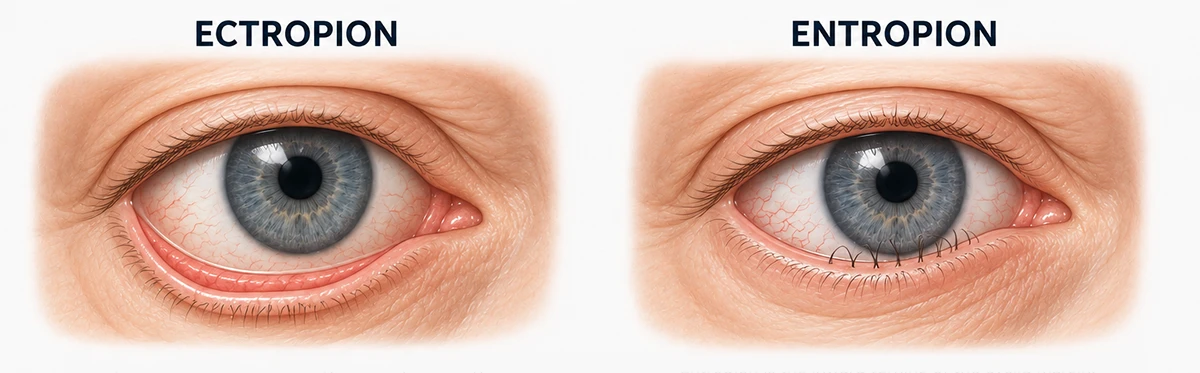
Ectropion is the outward turning of the eyelid margin, causing the inner conjunctival surface to become exposed. This prevents proper tear drainage and leaves the eye inadequately protected. The condition is most commonly age related (involutional), resulting from horizontal eyelid laxity and weakening of the eyelid retractors. It can also result from scarring (cicatricial), facial nerve palsy (paralytic), or mechanical factors such as eyelid tumours.
Entropion is the inward rolling of the eyelid margin, causing the eyelashes and skin to rub painfully against the cornea and conjunctiva. This constant abrasion can lead to corneal epithelial defects, ulceration, scarring, and potentially permanent vision loss. Entropion is most commonly age related due to eyelid laxity and disinsertion of the lower eyelid retractors. It may also be cicatricial (due to scarring from trauma, surgery, or inflammation) or spastic (due to involuntary eyelid muscle contraction).
Symptoms of ectropion and entropion
Ectropion:
- Excessive tearing (epiphora) due to the punctum being pulled away from the eye
- Redness and irritation of the exposed conjunctiva
- A gritty or foreign body sensation
- Dryness and burning, particularly with exposure to wind or air conditioning
- Crusting of the eyelid margin
- Mucous discharge
- Red, thickened, or roughened conjunctiva
Entropion symptoms
- Painful foreign body sensation from eyelashes rubbing against the eye
- Redness and irritation
- Excessive tearing (reflex tearing)
- Light sensitivity (photophobia)
- Mucous discharge
- Feeling that there is something constantly in the eye
- Corneal abrasion or ulceration in severe cases
Assessing ectropion / entropion
When you visit us at Sutherland Eye Surgeons, some of the tests that we perform may include:
External eyelid examination
Assessment of eyelid position, laxity, and symmetry, including measurement of the eyelid margin relative to the pupil and corneaSlit lamp examination
Evaluation of the conjunctiva, cornea, and eyelid margin for signs of exposure keratopathy, corneal epithelial defects, scarring, or ulcerationSchirmer's test
Assessment of tear production, which may be reduced in patients with eyelid malpositionCorneal fluorescein staining
Application of yellow dye to highlight corneal abrasions or ulceration caused by rubbing eyelashes or exposureEyelid laxity assessment
Gentle pulling of the eyelid to assess horizontal and vertical laxity, which guides surgical techniquePunctal assessment
Evaluation of the position of the punctum (tear drainage opening), which may be malpositioned in ectropionSnap back test
Assessment of eyelid tone by pulling the eyelid down and observing how quickly it returns to its normal position; delayed return indicates significant laxity
Treatment of ectropion and entropion
The specific technique depends on the type and cause of the eyelid malposition.
For ectropion, the most common procedure for age related cases is the lateral tarsal strip, which tightens the eyelid horizontally. A medial spindle procedure may be used when the inner portion of the eyelid is particularly lax, while retractor reattachment addresses cases where muscle disinsertion is contributing to the malposition. For cicatricial ectropion caused by scarring, a full thickness skin graft may be required, and severe cases may need a tarsal strip with a spacer graft.
For entropion, the most common surgical approach for age related cases is retractor advancement, which reattaches and advances the lower eyelid retractors to evert the eyelid margin. Horizontal lid shortening is often combined with this procedure to address both laxity and inturning. A full thickness eyelid wedge excision may be performed to tighten the eyelid, while posterior lamellar grafts are used for cicatricial entropion where scarring is the cause. For mild or temporary correction, an everting suture technique may be used.
Is your eyelid causing you discomfort?
If you are experiencing symptoms of ectropion or entropion, we are here to help. Contact Sutherland Eye Surgeons today to schedule a consultation with our oculoplastic specialists.
For all appointments and enquiries, please phone 02 9521 8402
Monday
Tuesday
Wednesday
Thursday
Friday
8:30am – 5:00pm
8:30am – 5:00pm
8:30am – 5:00pm
8:30am – 5:00pm
8:30am – 5:00pm
Suite 5, Level 1
570 President Ave
Sutherland NSW 2232
Website by: 