

Chalazion
Eyelid lumps
At Sutherland Eye Surgeons, we can perform a quick, minor surgical procedure to remove eyelid lumps that are causing discomfort or distorting your vision.
What is a chalazion?
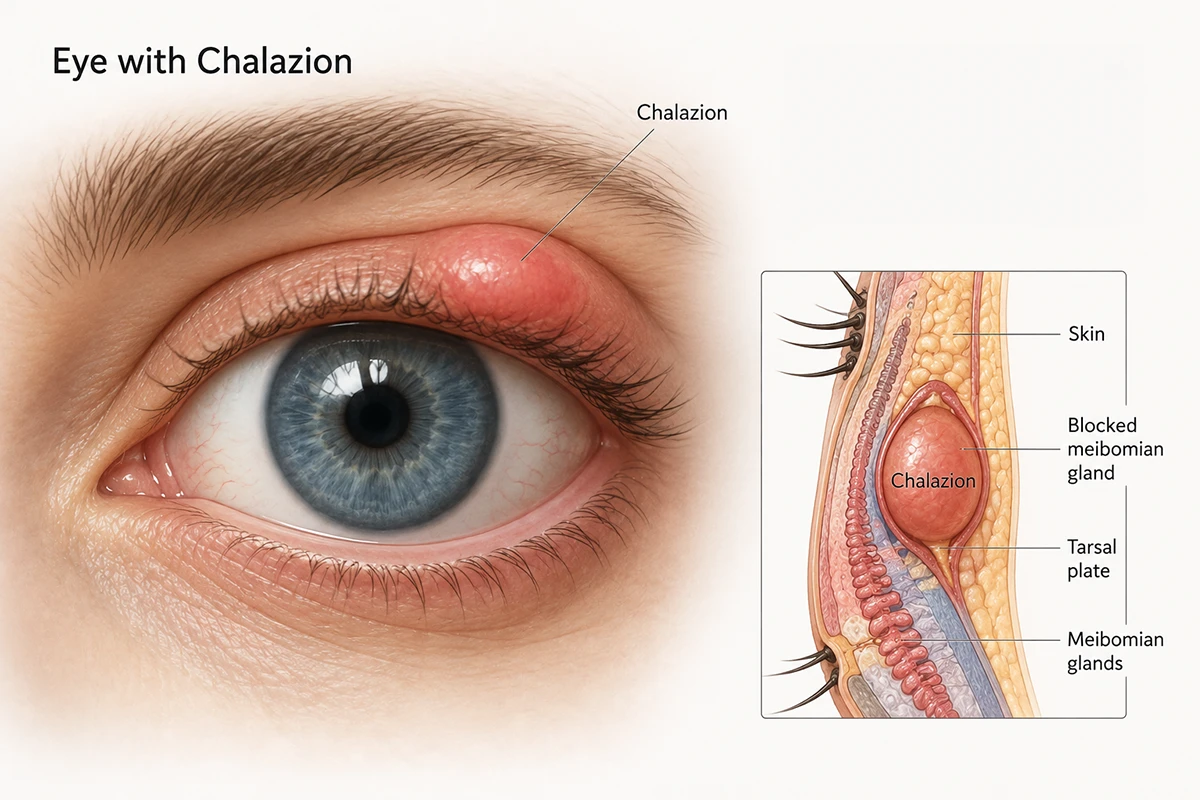
A chalazion is a firm, localised lump that forms on the eyelid when a meibomian (oil producing) gland becomes blocked. These glands are located within the tarsal plates of the upper and lower eyelids and secrete an oily substance that forms the outer lipid layer of the tear film.
When a gland becomes obstructed, accumulated secretions trigger a localised inflammatory response, resulting in a slowly enlarging nodule. Unlike a stye (hordeolum), which is an acute infection of an eyelash follicle or gland, a chalazion is typically non-infectious. However, secondary inflammation may cause redness and tenderness, and a chalazion can sometimes develop a secondary bacterial infection, leading to worsening redness and swelling.
Chalazia are generally not harmful and may resolve spontaneously over weeks to months. However, larger or persistent lesions can exert pressure on the cornea, potentially inducing astigmatism and visual distortion. Recurrent chalazia may indicate an underlying condition such as blepharitis, rosacea, or meibomian gland dysfunction.
Symptoms of a chalazion
Chalazia typically develop gradually over several days to weeks. Patients commonly experience:
- A firm bump on the upper or lower eyelid
- Gradual enlargement of the lump
- Mild redness and swelling in the surrounding eyelid tissue
- Tenderness if secondary inflammation develops
- Occasionally, blurred or distorted vision if the lump is large enough to press on the eyeball
Unlike a stye, a chalazion is usually not associated with the acute pain, localised pus, or marked tenderness characteristic of an infected eyelash follicle.
Assessing your chalazion
A thorough eyelid examination is essential to confirm the diagnosis of a chalazion and to exclude other eyelid conditions, including sebaceous gland carcinoma, a rare but aggressive malignancy. When you visit us at Sutherland Eye Surgeons, your specialist will review your medical history, assess the lump's size and consistency, and perform a slit lamp examination to evaluate the eyelid margin, meibomian gland openings, and ocular surface for signs of corneal irritation or associated blepharitis.
The eyelid is gently everted to examine the internal aspect of the lesion, and the specialist assesses for concerning features such as irregular borders, ulceration, loss of eyelashes, or failure to respond to conservative treatment. In most cases, the diagnosis is made on clinical examination alone, and no further testing is required.
If there is any suspicion of malignancy, a biopsy may be recommended. For patients with recurrent chalazia, we also assess for underlying blepharitis, meibomian gland dysfunction, or rosacea and provide a comprehensive management plan to reduce future occurrences.
Chalazion treatment
If you are seeing us at Sutherland Eye Surgeons, it is likely that conservative measures have been tried without success. You may have already tried warm compresses multiple times a day, followed by gentle massage toward the eyelid margin.
If so, our specialists offer in rooms minor surgical drainage (incision and curettage) performed under local anaesthetic through the inner surface of the eyelid to avoid a visible scar. These procedures are well-tolerated and take approximately 10–15 minutes.
For patients with recurrent chalazia, we assess for underlying conditions such as blepharitis, meibomian gland dysfunction, or rosacea and provide a comprehensive management plan to reduce future occurrences.
Is your eyelid lump not going away?
It can be removed with a quick in rooms procedure. Contact Sutherland Eye Surgeons today to schedule a consultation with our specialists.
For all appointments and enquiries, please phone 02 9521 8402
Monday
Tuesday
Wednesday
Thursday
Friday
8:30am – 5:00pm
8:30am – 5:00pm
8:30am – 5:00pm
8:30am – 5:00pm
8:30am – 5:00pm
Suite 5, Level 1
570 President Ave
Sutherland NSW 2232
Website by: 